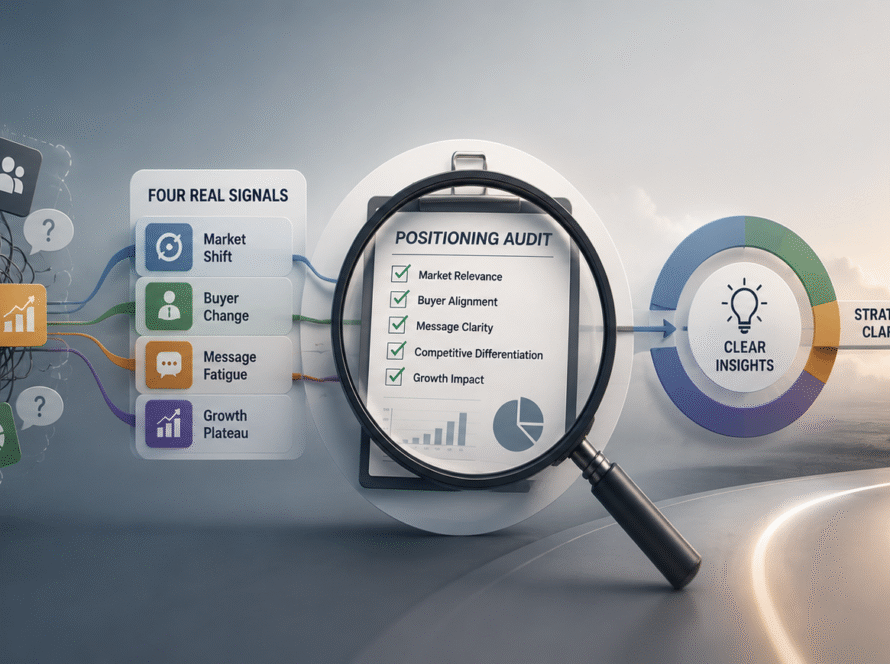


Picture two companies selling almost the same thing. One closes deals in three weeks at a fair price. The other gets stuck in “let me think about it,” then discounts to win. Same product. Very different outcome. Most of the time, the difference is positioning.
Here’s positioning in plain words: it’s the choice of how you want one specific buyer to see your product next to their other options. What you are, who it’s for, why it’s the better pick for them, and what sticking with their current way actually costs. That’s the whole idea. No jargon required.
Why it’s worth your attention: when positioning is clear, good things start happening on their own. Marketing gets cheaper because the right people recognize themselves. Sales get faster because prospects arrive half-convinced. The wrong-fit buyers who drain your team quietly filter themselves out. When positioning is fuzzy, you pay for it for years without ever seeing a line item for it.
This guide walks through how to get it right, in order, with plain examples and a few honest tests you can run this week.
In plain terms: Product positioning is the deliberate choice of how a specific buyer should understand your product compared to their alternatives. It’s a decision you make before any copy gets written, and getting it right makes every later marketing and sales effort cheaper and easier.
- Positioning is a decision, not a tagline. You decide who you’re for and why you’re the better choice, and the words come later.
- It’s different from messaging, branding, and differentiation. Mixing them up sends you chasing the wrong fix.
- Work through five things in order: competitive alternatives, your real strengths, the value they create, your best-fit buyer, and finally your category.
- Write it down as one internal sentence, then test it: if a competitor could paste their name into it and it still reads true, it isn’t sharp yet.
- New for 2026: buyers research with AI before they talk to you, so your positioning now has to be clear enough for a machine to explain. If AI can’t, your buyer’s champion probably can’t either.
- Never ship positioning you haven’t checked against real buyers. A few sales-call recordings will tell you more than a month of internal debate.
What positioning actually is (and three things it isn't)
Positioning lives in your buyer’s head, not on your website. It’s the quick mental file they put you in during the first few seconds. You can’t fully control that file, but you shape it, and companies that shape it on purpose win more often than companies that leave it to chance.
Three things get mixed up with positioning all the time, and the mix-up is expensive. Sorting them out is the first practical win.
Positioning is not messaging. Positioning is the strategy. Messaging is the words you use to say it out loud. Positioning changes may be once a year. Messaging gets rewritten all the time. So when a headline falls flat, the reflex is to hire a better writer, but a weak headline is usually a positioning problem in disguise. No amount of clever copy helps if you haven’t decided who you’re for and why they’d choose you.
Positioning is not branding. Branding is your look and personality, the colors, the logo, the voice. Positioning is the claim underneath all of it. You can have beautiful branding and still leave a buyer thinking “I have no idea what this does or whether it’s for me.” That’s a positioning gap wearing a nice outfit.
Positioning is not differentiation. Differentiation is a real, concrete difference, like a feature or a price. Positioning is the meaning you build around it. Apple and Samsung sell phones with similar specs and sit in completely different places in people’s minds. Neither changed a chip to get there. Slack did the same in B2B by calling itself “work messaging, not email.” Email still worked fine. Slack just changed the frame around it, and that was a positioning choice, not a product one.
The business takeaway: if you’ve been “fixing the website” again and again and nothing sticks, you may be solving the wrong layer. Sort out the decision underneath, and the words get easy.
What good positioning does for your business (and what fuzzy positioning costs)
It helps to see the money side clearly, because positioning can feel abstract until you connect it to outcomes.
Start with a sobering number. When CB Insights studied why startups fail, about 35% came down to “no market need”. Dig in and the product often worked fine. The story didn’t. The team built around features they were proud of instead of the problem the buyer actually felt, and the two never connected. Positioning is what connects them.
Next, the most common way deals quietly die. April Dunford, who has done this work for hundreds of companies, estimates that 40 to 60% of B2B purchases end in no decision. The buyer doesn’t pick a competitor. They pick nothing, because they never got clear enough to act. Clear positioning is one of the few things that directly lowers that number, and every deal you rescue from “no decision” is revenue you already earned but weren’t collecting.
There’s also the sea-of-sameness problem. Gartner found that 64% of B2B buyers can’t tell one company’s digital experience from another’s. When a buyer can’t tell you apart, the only thing left to compare is price, and that’s a race you don’t want to win. Distinct positioning is how you stop competing on discounts.
Now the upside, because it’s just as real. When HubSpot stopped trying to serve “anyone who needs marketing software” and focused on one specific buyer, the company grew from $15M to $270M in four years. Narrowing felt like giving up market. It actually unlocked growth. Being specific isn’t a brake. It’s usually the accelerator. That’s the outcome you’re working toward.
Not sure whether your positioning is costing you deals?
The “no decision” losses and the discounting both leave the same fingerprint: a buyer who never got clear enough on why you’re the better choice. The hard part is that it’s nearly impossible to see from inside your own company.
That’s what a positioning diagnostic is for. Share your homepage and you’ll get a plain read on where buyers are getting confused, what it’s likely costing you, and the two or three fixes worth doing first.
The five-step method that actually works (and why order matters)
There are dozens of positioning frameworks. Most just list the same pieces in a box and leave you wondering where to start. The method below, developed by April Dunford, works because it’s a sequence. You figure out the pieces in this order, and each one feeds the next.
Step 1: Competitive alternatives. Ask a simple question: if your product vanished tomorrow, what would your best customer use instead? Usually, it’s not a rival tool. It’s a spreadsheet, a manual process, an intern, or just doing nothing. This matters because your strengths only mean something next to the option the buyer is really weighing. Business value: it tells you what you’re actually being compared against, so you stop arguing points the buyer doesn’t care about.
Step 2: Your real strengths. List what you can do that those alternatives can’t. Keep it to facts, not adjectives. Features, your method, your data, the way you’re built. Just the true things that are yours and not theirs. Business value: this is the raw material for every reason-to-buy you’ll ever give.
Step 3: The value those strengths create. Turn each strength into a plain benefit, then add proof. The strength is “we get you live in one sprint.” The value is “you see results this quarter, not next year.” The proof is a customer who actually did it. A strength with no value attached is trivia. A value with no proof is just a claim, and buyers have learned to ignore claims. Business value: this is what makes a prospect lean in and a champion able to defend you internally.
Step 4: Your best-fit buyer. Describe the buyer who cares most about the value only you can give. Get specific enough that it excludes people. Not “marketing teams,” but “product marketers at early-stage SaaS companies with a launch coming up.” Business value: specific targeting lowers your cost to acquire and raises your win rate, because you stop spending on people who were never going to buy.
Step 5: Your category. Last, pick the label that makes everything above click instantly. Call yourself “analytics software,” and buyers expect one thing. Call yourself a “workflow tool”, and they expect another. The right category makes your strengths obvious in a second. The wrong one buries them. Business value: the right frame means buyers “get it” faster, which shortens your sales cycle.
Here’s why the order matters so much. Most teams start at Step 5 and pick the biggest, most ambitious category they can, then bend everything else to fit. That’s backwards, and it’s why their positioning feels hollow. Category is the conclusion, not the starting line. Work the steps in order and the right category almost picks itself.
Write it down: the positioning statement
Once you’ve worked through the five steps, capture them in one internal sentence. This is for your team, not your homepage. Nobody outside the company should ever see it. Its only job is to keep product, marketing, and sales telling the same story.
A simple, reliable format:
For [specific buyer] who [need or pain], is a [category] that [main value], because [reason to believe].
Then run one quick test that saves you from generic positioning. Fill in the sentence, then imagine your closest competitor pasting their own name into it. If it still reads as true, you don’t have positioning yet. You have category copy that anyone could claim. Strong positioning makes a competitor a little uncomfortable because it claims ground they can’t honestly take.
One thing matters more than the formula: use your buyer’s words, not your internal ones. The phrases your team invented in a meeting are rarely the phrases your customer uses when they describe the problem to a colleague. Pull the real words from sales calls and customer conversations and use those. The closer your language is to what’s already in the buyer’s head, the less effort it takes them to understand and trust you.
If you’d like a second set of eyes on this, that’s exactly what BrandOrbitX does. Share your homepage, and you’ll get a clear read on how a cold buyer, a busy committee member, and an AI all describe you today, plus the highest-value fixes. Book a positioning diagnostic →
Pick the approach that fits your situation
There isn’t one correct strategy. There’s the one that fits your market, your stage, and what your buyer responds to. Here are the common ones, with the honest trade-off attached to each, so you can choose with eyes open.
| Approach | How it works | Best when | Watch out for |
|---|---|---|---|
| Against an alternative | Name a clear "enemy" and be the better way. HubSpot named cold outbound and championed inbound. | There's a leader everyone knows and you have a real edge | It's reactive. If the enemy fixes the problem, your position weakens. |
| Use-case / niche | Own one specific job that broad tools do badly. | Sharp pains the big all-in-one tools ignore | A genuinely tiny niche can cap your growth. |
| Premium / outcome | Charge more, promise the better result, not the lower price. | High-stakes work: regulated, enterprise, mission-critical | You need real proof. A premium claim with no evidence reads as arrogance. |
| Value / accessible | Be the affordable, simpler option against bloated incumbents. | Crowded markets with expensive, over-built leaders | Thinner margins, and you attract price-shoppers who leave for the next deal. |
| Category creation | Name a problem nobody named and own the answer. Notion did this with "all-in-one workspace." | A genuinely new capability with no existing label | Very expensive to teach the market. |
That last one deserves a gentle warning because it’s the most tempting and the most misused. Creating a category means paying to teach the whole market a new way to think before you can sell to them. Dunford’s rough rule is that you need something like nine figures of revenue to fund that education. Below that, you’re almost always better off competing in a category buyers already understand, with sharper differentiation inside it. DocuSign learned this when it tried to move from the clear “e-signature” label to an “Agreement Cloud” category and created confusion instead of clarity.
A simple way to choose: still finding who you’re for, go niche and specific. Established but crowded, position against the alternative or own a use case. Moving into a new segment, lead with the outcome and fresh language. Genuinely new technology with real funding, and only then, consider creating a category.
Three examples that teach the lever
Examples help only when they show the move. Here are three.
Slack: reframe, don’t rebuild. Slack didn’t beat email on features. It changed the frame to “the end of internal email.” Same capability, new mental slot. The lesson: positioning is often a fresh frame on what you already have.
HubSpot: the courage to narrow. By choosing one buyer and one belief, HubSpot got a clear hero, a clear villain, and a clear customer. The big growth came after the narrowing, not before. The lesson: being specific compounds.
The “CRM for investment banks”: win where you can win first. One company Dunford worked with repositioned from a broad CRM to the CRM for investment banks, because that was a fight they could actually win. After dominating there, they expanded to retail banking, then wider. The lesson: win the room you’re in now, then grow from strength. Trying to be for everyone on day one is how you end up for no one.
The new test for 2026: can an AI explain you?
Here’s a shift that makes positioning matter more than ever, and it’s easy to check. Your buyer mostly decides before they ever talk to you. They’re roughly 70% through their research before they contact a seller, and 94% now use AI tools somewhere in that process. Often, the shortlist forms inside an AI answer you never see.
So your positioning now has to work for two readers, both without you in the room: a human skimming your homepage in a few seconds, and an AI building a shortlist when someone asks it for “the best [your category] for [their situation].” If your positioning is mushy, the AI can’t summarize you cleanly, so it skips you or blends you into the crowd. You don’t lose the deal. You never enter it.
The fix is that the same clarity and good positioning are always needed. And there’s a neat shortcut to test it: open ChatGPT or Perplexity, ask it to recommend the best tool or partner for your exact buyer and situation, and see whether you appear and whether the description is right. If you’re missing or described incorrectly, that’s not an AI glitch. It’s your positioning, and the AI just made it visible. Fixing it helps your human champions too, because a message clear enough for a machine to repeat is clear enough for a person to repeat.
Don't bet the company on an untested guess
Many teams write a positioning statement, feel good about it, and ship. Then they learn whether it worked six months later, measured in a slow pipeline and prospects who say “I wasn’t sure what you did.” That’s an expensive way to find out. A little checking up front saves a lot.
The gap is never between having a statement and not having one. It’s between what’s obvious to you and what a first-time buyer actually understands. You’ve lived with this product for months, so things that feel clear to you can be invisible to them. Here are four honest ways to close that gap, none of which need a special vendor:
Listen to your sales calls. The cheapest signal you already own. Play ten recorded calls and write down the exact words prospects use for the problem, the moments they perk up, and the objections that keep coming back. If your positioning doesn’t match their language, change yours.
Run win-loss conversations. Talk to deals you won and lost, especially the ones that chose no one. Buyers and sellers agree on why a deal was lost only about 15% of the time, so the reasons in your CRM are mostly guesses. The real reasons come from asking the buyer.
Show the message to real buyers. Put your draft in front of people who match your ideal customer and find out if they get it. The discipline that matters: test whether the message is clear and lands, not just which of two headlines you happen to prefer.
Have a few deeper conversations. When something puzzling comes up, talk to a handful of people in your target market. It’s slower, but it’s where you catch the framing you’d never have guessed. A scheduling tool that thinks it sells “time savings” sometimes discovers buyers really want “visibility,” and that one insight can reshape everything.
A quick, fair note on the AI tools that simulate buyer interviews: they’re handy for a fast first read when you have no time or budget, and they skip some of the politeness real interviews suffer from. But they model your buyer rather than interview them. Use them to form ideas quickly, then confirm the important calls with real people. Don’t bet a full repositioning on a simulation alone.
How to tell your positioning needs work
A quick, friendly gut-check. It’s probably time to revisit your positioning if any of these feel familiar:
- Sales calls open with a lot of explaining before the prospect “gets it.”
- Ads underperform no matter how good the creative is.
- Buyers keep comparing you to the wrong alternatives.
- Your win rate sits below 15%, a common sign you’re talking to the wrong buyers.
- Your own team describes what you do three different ways.
The sharpest test is the last one in spirit: can a happy customer explain what you do in one clean sentence, without your help? In B2B, that customer often has to sell you internally to a group of six to ten people while you’re nowhere near the room. If they can’t say it simply, the deal can quietly stall. None of these mean you’ve failed. They just mean the decision underneath needs another pass, and that’s fixable.
Frequently Asked Questions
It’s how you want a specific buyer to see your product compared to their other options: who it’s for, what it is, why it’s the better choice, and what their current way is costing them. It’s a decision you make before writing any marketing copy.
Positioning is the strategy, the place you want to hold in the buyer’s mind. Messaging is the words you use to express it. Positioning changes rarely; messaging is refined often. A weak headline is usually a positioning problem underneath.
A short internal sentence that keeps your team aligned: “For [buyer] who [need], is a [category] that [value], because [proof].” It’s not a tagline, and nobody outside the team should see it.
Check it against real buyers. Listen to sales calls for their actual words, run win-loss conversations, show the message to people who match your ideal customer, and have a few deeper interviews. The goal is to confirm buyers can clearly say what you do, who it’s for, and why it matters.
Rarely. Creating a category means funding market education before demand exists, which usually takes very deep pockets. Most companies do better competing in a category buyers already understand, with sharper differentiation.
Buyers now research with AI before they contact sales, and they often build their shortlist from AI answers. If your positioning isn’t clear enough for an AI to summarize correctly, you can be left off the list entirely. Clear, specific positioning is what both AI and human champions can repeat.
Most positioning problems are clear to everyone except the team living inside them, and that’s completely normal. If you’d like an outside read on yours, BrandOrbitX will show you how a cold buyer, a busy committee member, and an AI each describe you today, where you’re getting skipped, and the fixes worth doing first. — positioning that pipelines.