


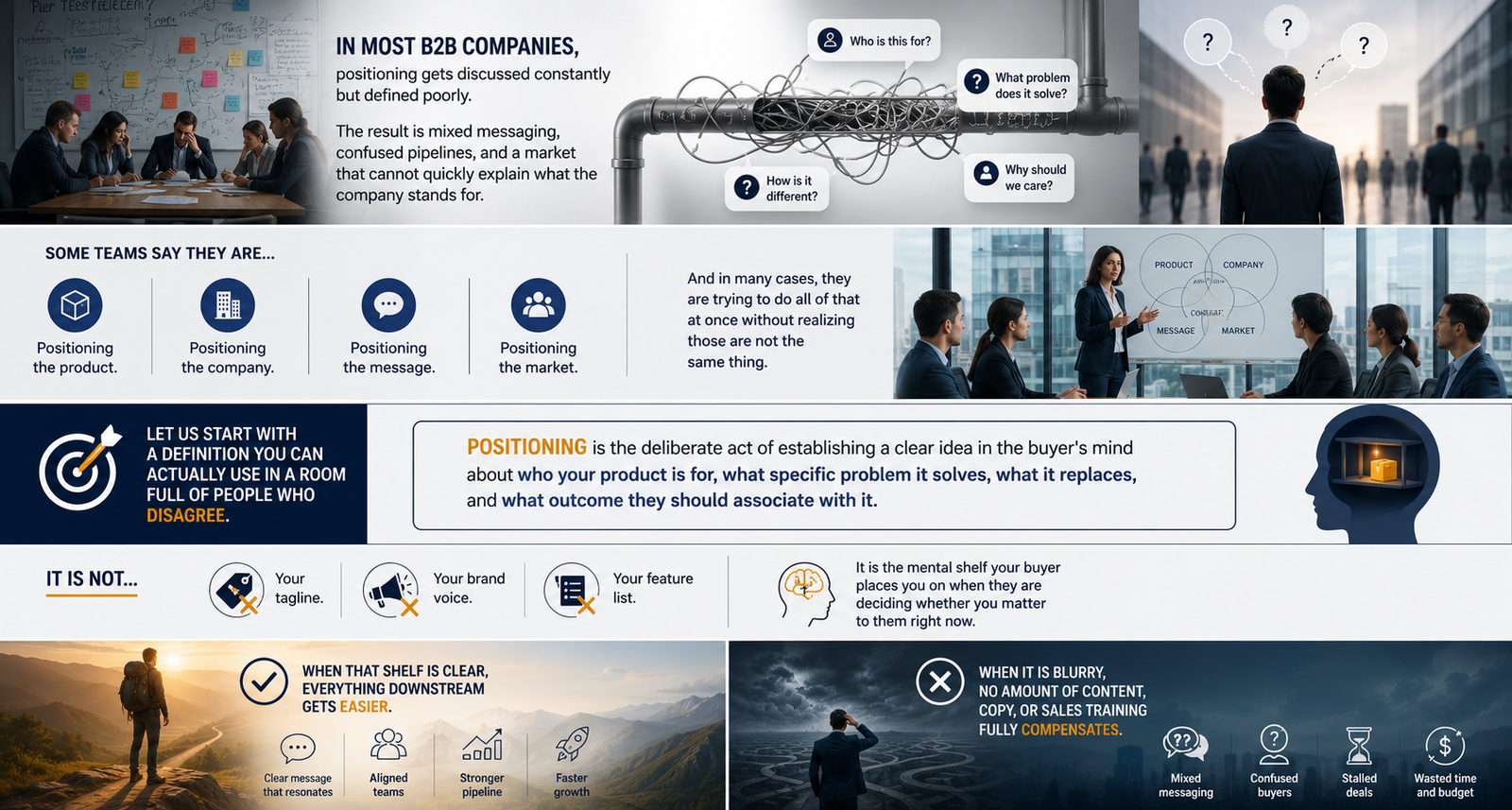
In most B2B companies, positioning gets discussed constantly but defined poorly. The result is mixed messaging, confused pipelines, and a market that cannot quickly explain what the company stands for.
Some teams say they are positioning the product. Some say the company. Some say the message. Some say the market. And in many cases, they are trying to do all of that at once without realizing those are not the same thing.
Let us start with a definition you can actually use in a room full of people who disagree.
Positioning is the deliberate act of establishing a clear idea in the buyer’s mind about who your product is for, what specific problem it solves, what it replaces, and what outcome they should associate with it.
It is not your tagline. It is not your brand voice. It is not your feature list. It is the mental shelf your buyer places you on when they are deciding whether you matter to them right now.
When that shelf is clear, everything downstream gets easier. When it is blurry, no amount of content, copy, or sales training fully compensates.
Why Positioning Gets Confused With Everything Else
One reason positioning is hard to align on internally is that different teams use the word to mean different things.
A founder hears positioning and thinks about perception. A marketer hears it and thinks about messaging. A sales leader hears it and thinks about competitive differentiation. A product team hears it and thinks about features. All of those matter. None of them are positioning.
Here is a comparison that clears this up quickly.
| Repositioning | Messaging | Branding | Differentiation | |
|---|---|---|---|---|
| What is it | The strategic frame the buyer uses to categorize you | The language that expresses the position | The visual and emotional identity | The specific reasons you are better than alternatives |
| What it answers | Who is this for, and what does it replace? | How do we talk about it? | How do we look and feel? | Why us over them? |
| What breaks if it is wrong | The wrong buyers show up | The right buyers do not understand | The brand feels forgettable | Deals stall at comparison |
| Order of operations | First | Second | Parallel | Derived from positioning |
If you change your messaging without fixing your positioning, you are rearranging words on a frame the market is not using. That is why so many messaging refreshes feel like they work for a week and then stop mattering.
The 4-Layer Positioning Framework
When we work with B2B teams at BrandOrbitX, we use a structure called the 4-Layer Positioning Framework. It breaks positioning into four decisions that must be specific and aligned.
Layer 1: The Buyer
Not a broad audience. Not “mid-market companies with a problem”. The real buyer is the person who feels the pain strongly enough to act and has enough influence to move a decision forward. If this layer is vague, every other layer gets fuzzy.
Layer 2: The Problem
Most companies describe their product before they define the problem. But buyers do not buy products first. They buy solutions to problems they already care about. If your problem statement is too broad, yourpositioning loses sharpness immediately.
Layer 3: The Alternative
This is the layer most teams skip, and it is the one that matters most for conversion. What are you actually replacing? A spreadsheet? A legacy system? A manual process? A “do nothing” decision? If you cannot name the alternative, the buyer cannot understand what category to place you in. This is what we call The Replacement Test. If your positioning does not pass it, the market will not understand why you exist.
Layer 4: The Outcome
Not a list of benefits. One concrete result you want to be remembered for. Faster execution. Lower risk. Better visibility. The outcome must be specific enough that the buyer can picture the value without you in the room.
When all four layers are sharp and aligned, positioning starts doing its real job. It pre-sells. It filters. It creates urgency. And it gives your champion the language to sell internally without you.
Not sure which of the four layers is leaking clarity in your positioning?
BrandOrbitX runs structured positioning audits that identify exactly where your buyer, problem, alternative, or outcome is too broad — and what to sharpen first.
A Positioning Statement Template You Can Use Right Now
If you need a starting point, this structure works across almost every B2B category. For [specific buyer in a specific situation] who [specific problem or pressure], [Company] is the [category] that [key differentiator]. Unlike [the alternative you replace], we [specific outcome that matters now].
The value of this template is not in the words. It is in the discipline. If any blank feels generic, that is exactly where your positioning is leaking clarity.
The Flexibility Trap: Why Safe Positioning Rarely Works
The most common mistake we see is teams making positioning too broad because they do not want to miss opportunities. They keep the buyer definition flexible. They keep the use case wide. They keep the story safe.
But safe positioning is rarely strong positioning.
The more you try to appeal to everyone, the harder it becomes for anyone to feel specifically chosen. And in B2B, buyers respond to specificity. They want to know whether you understand their world, whether your solution fits their situation, and whether you are meaningfully different from the status quo.
If they cannot see that quickly, they move on. Not to a competitor. To doing nothing.
Volume is not the fix for confusion. Clarity is.
Does Positioning Affect Pricing?
This is one of the most searched questions on this topic, and the answer is yes, directly.
Positioning defines the category your buyer compares you against. If you are positioned against a spreadsheet, you compete on cost. If you are positioned against a strategic outcome or a legacy system that carries risk, you compete on value.
Teams that reposition often discover pricing power they did not know they had. The product did not change. The shelf it sat on did.
A Simple Test You Can Run Today?
Show your homepage to five people who match your target buyer profile but have
never heard of your company. Give them 10 seconds. Then ask:
What does this company do?
Who is it for?
What does it replace?
Why would you use it now instead of doing nothing?
If they cannot answer all four confidently, your positioning needs work. Not your
product. Not your team. Your positioning.
Frequently Asked Questions
You are positioning a clear idea in the buyer’s mind about who the product is for,
what problem it solves, what it replaces, and what outcome to expect. It is not a
tagline or a brand exercise.
Positioning is the strategic decision. Messaging is the language that expresses it.
Changing messaging without fixing positioning rarely improves conversion.
Buyers evaluate you against what they currently use. If your positioning does not
name that alternative, the buyer cannot understand your category or your value.
Formally every 12 to 18 months. Informally, every time your closed-won pattern
shifts. The trigger is data, not a calendar.
Positioning cannot fix a broken product. But it can fix a pipeline full of the wrong
conversations. If your pipeline is active but not converting, positioning is the first
place to look.
We are not just positioning a product. Or a company. Or a message.
We are positioning a clear idea in the buyer’s mind about who this is for, what
problem it solves, what it replaces, and why it matters now.
When that becomes clear, everything else aligns. Marketing knows what to say.
Sales knows how to frame it. Buyers know why they should care.
The market rarely rewards the brand that says the most. It rewards the brand
that is understood fastest.
Ready to stop compensating for unclear positioning with more content and longer sales calls?
Get a free positioning audit. We will review your messaging, your replacement test,
and your closed-won patterns to show you exactly where clarity is missing.